An event brings a lot of people and resources together for a relatively short period of time.
Food, drinks, transport, technical equipment, furniture, printed materials and temporary installations may all be used for just a few hours.
That makes events a useful place to look for practical ways to reduce unnecessary consumption and waste.
Food waste is one of the most obvious places to start.
It is tangible, measurable and directly connected to both cost and resource use. But a more responsible event is not only about the menu. Venue choice, transport, scenic design, printed materials, single-use products and supplier logistics also matter.
This guide looks at practical decisions that can reduce waste without making the event less enjoyable.
How can you make a corporate event more sustainable?
There is no single choice that makes an event sustainable.
A better approach is to look at the full event and identify the areas where you can realistically reduce waste and resource use.
Five useful areas to start with are:
- Food and drinks
- Venue
- Transport
- Materials and scenic design
- Waste and reuse
You do not need to change everything at once.
In many cases, two or three meaningful improvements are more valuable than a long list of small initiatives that are difficult to measure or have very little impact.
The five focus areas
- Food and drinksGuest count, service and surplus
- VenueLocation and existing facilities
- TransportGuests and suppliers
- Materials and scenic designReuse, rental and merchandise
- Waste and reuseSorting that is easy for guests
Reducing food waste starts with the guest count
The simplest way to reduce food waste is to avoid producing more food than you need.
In practice, that is harder than it sounds.
Invitations may go out weeks in advance. Some guests cancel late. Others never respond. And most organisers would rather have slightly too much food than risk running out.
The result can be a large safety margin built into the catering order.
That is why the final guest count should not be treated as a purely administrative detail. It should be part of the catering strategy.
Ask your caterer or venue:
- When does the final guest count need to be confirmed?
- How much buffer does the kitchen normally add?
- Can the number be adjusted a few days before the event?
- Which parts of the menu need to be prepared far in advance?
- What happens to food that is prepared but not served?
The better the communication between the organiser and the kitchen, the less need there is to overproduce.
Where does food waste happen?
- InvitationsSent weeks in advance
- RSVPsLate cancellations and no replies
- Final guest count (where the organiser can reduce uncertainty)When is the number locked?
- Production (where the organiser can reduce uncertainty)What is prepared far in advance?
- ServiceServing format and portions
- SurplusFood that is not eaten
Buffet or plated service: Which creates less food waste?
Serving format affects both the guest experience and the amount of food the kitchen needs to prepare.
A large buffet can be flexible and informal, but it may also require many dishes and large quantities to be displayed at the same time.
Plated service makes portion sizes easier to control.
That does not mean a buffet is always the wrong choice. A buffet can be planned more precisely by:
- using smaller serving dishes and refilling them gradually
- limiting the number of parallel dishes
- using smaller plates where appropriate
- placing vegetables, salads and sides early in the buffet flow
- coordinating refills closely between the kitchen and service team
The Danish Veterinary and Food Administration recommends that professional kitchens consider serving format, portion size and the placement of food as practical tools for reducing food waste.
The right solution depends on the size and format of the event, but the serving style should be a deliberate planning decision.
From planning to less food waste
- Accurate guest countAgree the deadline and buffer with the kitchen
- Appropriate serving formatPlated service or a well-planned buffet
- Gradual refillingSmaller dishes, refilled as needed
- Plan for surplus foodAgree in advance what happens to leftovers
Design the menu around the event, not around tradition
Food is an important part of many corporate events.
But a good menu does not need to contain the largest possible number of ingredients, several types of meat or an excessive number of courses.
A shorter, more focused menu can be easier for the kitchen to plan and often creates a more coherent dining experience.
You can consider:
- more vegetables and plant-based dishes
- seasonal ingredients
- fewer primary ingredients
- dishes that use ingredients across several parts of the menu
- local suppliers where this makes practical sense
- fewer menu choices with a higher level of quality
The important point is that resource-conscious decisions should not be added as a separate layer after the menu is designed.
If they are part of the concept from the beginning, they can support the overall experience.
What should happen to surplus food after the event?
Even with careful planning, there may still be food left over.
The time to discuss surplus food is not after the last guest has left.
Agree the process with the venue or caterer in advance.
Depending on the type of food and how it has been handled, options may include:
- using suitable ingredients or prepared components in other kitchen production
- offering suitable leftovers to guests
- allowing the venue or caterer to reuse safe surplus food internally
- donating suitable surplus food through an appropriate organisation, where food-safety rules allow it
Food safety always comes first.
Food that has been left out or stored incorrectly may not be suitable for reuse or donation. The Danish Veterinary and Food Administration provides specific guidance on surplus food and food safety.
The organiser’s role is to make sure the question is addressed before the event, so usable food does not become waste simply because nobody decided what should happen to it.
Measure food waste if you want to improve the next event
If your company runs events several times a year, it can be useful to record what is left over.
This does not need to be complicated.
After the event, the venue or caterer could note:
- how much food was produced
- the actual number of guests
- unused food from the kitchen
- food served but not eaten
- which dishes created the most surplus
That gives you a much stronger basis for the next event than simply hearing that there was “a bit too much food”.
If catering for 150 guests repeatedly creates enough food for 180, you have something concrete to adjust.
Venue choice can simplify several sustainability decisions
A venue’s location and existing facilities influence several parts of the event at the same time.
A venue close to public transport can make it easier for guests to arrive without private cars or dedicated transfers.
A venue with existing furniture, kitchen facilities, sound, lighting and stage equipment can also reduce the need to transport and build temporary solutions.
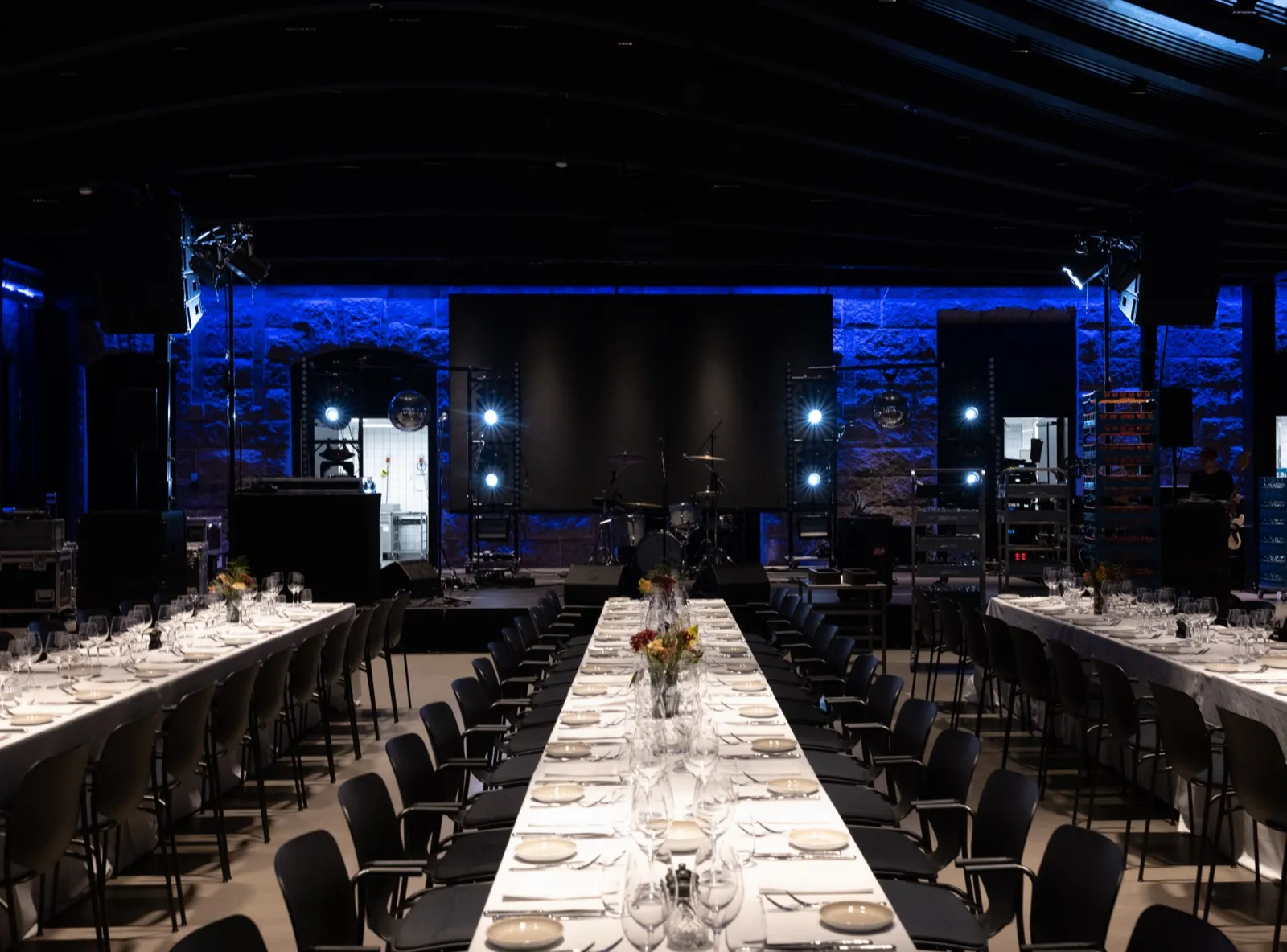
When comparing venues, ask:
- How will guests get there?
- What furniture is already available?
- What technical equipment is included?
- How is waste separated?
- How does the kitchen manage food waste?
- Can scenic elements and decoration be reused?
- Which parts of the event require additional transport and temporary production?
A spectacular empty space can offer a lot of creative freedom, but it can also require much more equipment and infrastructure to be brought in.
That does not mean raw venues are a bad choice. It simply means resource use should be considered alongside aesthetics, budget and production needs.
Transport: Think about guests and suppliers
Transport is not only about how guests travel to the event.
Catering, AV, flowers, furniture, scenic design, staff and entertainment may all arrive from different suppliers.
That can create a significant amount of logistics.
Ways to reduce unnecessary transport include:
- choosing a venue close to the majority of guests
- prioritising access to public transport
- consolidating deliveries where possible
- choosing suppliers located closer to the venue
- using the venue’s existing furniture and technical equipment
- planning load-in carefully to avoid unnecessary return trips
For larger events, communicate transport options clearly in the invitation.
If public transport is the easiest option, guests should know that before they decide how to travel.
Reuse scenic design and event materials
Many events are designed for one specific day.
That may be appropriate for the experience, but it does not mean every physical element should only be useful once.
Think about the next use while the design is still being developed.
For example:
- signage can be designed so dates and individual messages can be replaced
- stages and walls can be modular
- furniture and decoration can be rented rather than purchased
- flowers and plants can have a second life after the event
- scenic elements can be reused at future events or trade shows
- reusable badge holders can be collected where the format allows it
This can also make future events less expensive.
A well-designed element that works several times may be both better design and better economics than a cheaper single-use solution.
Avoid merchandise without a clear purpose
Goodie bags and branded giveaways are common at corporate events.
Before producing 300 branded items, ask one question:
Would guests still want to take this home if your logo was not printed on it?
If the answer is no, the item may not be necessary.
Instead, consider:
- fewer, better items
- something guests use during the event and can keep afterwards
- digital materials
- an experience or service instead of a physical item
- no merchandise at all if it does not add value
This is not an argument against physical details.
Physical objects can make an event feel more memorable and tangible. The point is to use materials because they contribute to the experience, not simply because they are expected.
Make waste sorting easy for guests
Waste sorting only works if guests and staff understand the system.
Five bins in a dark corner with small labels do not automatically create better sorting.
Placement, signage and staff briefing matter.
Make sure:
- sorting points are placed where waste is created
- categories are clearly labelled
- guests do not need to guess
- backstage and kitchen areas follow the same clear system
- suppliers understand the requirements before the event
At larger events, a clear briefing for the venue, catering and production teams may be more effective than adding more signage for guests.
Can a more sustainable event also cost less?
Sometimes.
Some measures cost more. Others can reduce costs.
Producing less excess food lowers purchasing costs directly.
Reusing scenic design can reduce future production costs.
Using a venue’s existing furniture and AV can remove the need for additional deliveries and rentals.
Fewer printed materials and less merchandise reduce both production and logistics.
Sustainability should therefore not automatically be treated as an extra line in the budget.
Some of the most effective improvements simply involve using fewer resources on things that do not create meaningful value for guests.
Prioritise what makes a real difference
When sustainability becomes a long checklist, it is easy to focus on the most visible details.
The paper straw gets ten minutes of discussion while 40 untouched meals remain in the kitchen.
A better approach is to prioritise by scale.
Ask:
- Where does the event use the most resources?
- Where does the largest amount of waste occur?
- Which decisions can we actually influence?
- Which improvements can be repeated at future events?
- Can we document what we say we have done?
The last question is important.
A responsible event is not about being able to label it “green”. It is about being able to point to specific decisions and outcomes.
Be careful with broad sustainability claims
If you communicate publicly about the environmental aspects of an event, specific statements are usually better than broad claims.
For example:
“We reduced the number of single-use items and based the catering order on the final confirmed guest count.”
is more specific than:
“This was a sustainable event.”
In Denmark, environmental and sustainability claims in marketing are subject to strict documentation requirements. Danish rules are being tightened further from 27 September 2026.
That does not mean companies should avoid talking about their actions.
It means those claims should be specific, understandable and supportable.
Checklist for a more responsible corporate event
Food and drinks
- Is the guest count as accurate as possible?
- When is the catering number locked?
- Does the kitchen have a plan to limit overproduction?
- Does the serving format suit the guest count?
- Have portion sizes been considered?
- What happens to surplus food?
Venue and transport
- Can guests reach the venue easily by public transport?
- Can the venue’s existing furniture and technical equipment be used?
- Can deliveries be consolidated?
- How does the venue manage waste and food waste?
Materials and production
- Can existing scenic elements be reused?
- Can new elements be designed for more than one event?
- Are all printed materials necessary?
- Does event merchandise serve a real purpose?
- Can anything be rented rather than purchased?
After the event
- Is the actual guest count recorded?
- Is food waste or surplus recorded?
- Are materials stored or reused?
- Are lessons documented for the next event?
Frequently asked questions about sustainable events and food waste
How can you make a corporate event more sustainable?
Start with the areas that use the most resources: food and drinks, transport, venue, materials and waste. Choose a few concrete actions that can be planned and documented rather than trying to change everything at once.
How can you reduce food waste at a company event?
Use the most accurate guest count possible, agree the final adjustment deadline with the caterer, choose a serving format that makes quantities easier to manage and decide in advance what should happen to suitable surplus food.
Is a buffet always worse for food waste?
No. Large buffets can require more food to be displayed at once, but smaller serving dishes, gradual refilling and close coordination between the kitchen and service team can make quantities easier to manage.
Can surplus food from an event be donated?
Sometimes, but food-safety, storage and traceability rules must be followed. Agree the process with the venue, caterer and any receiving organisation in advance and follow current Danish food-safety guidance.
Is a more sustainable event more expensive?
Not necessarily. Reducing food waste, reusing scenic elements, using fewer single-use materials and relying on a venue’s existing equipment can also reduce costs. Other choices may cost more, so decisions should be considered in the context of the full event budget and purpose.
Should sustainability be part of your next event brief?
Sustainability works best when it is considered from the start rather than added at the end.
At Skov.Studio, we work across both creative direction and practical event production. That makes it possible to consider venue, catering, suppliers, materials and delivery as one connected experience.
If you are planning a corporate event in Denmark and want to make more considered choices along the way, we can help shape an approach that works for the guests, the budget and the production.